
Myth vs. Reality: Why ‘Floodlighting’ an Underground Mine is a Critical Safety Error
The Pervasive Myth of ‘More Light Equals More Safety’
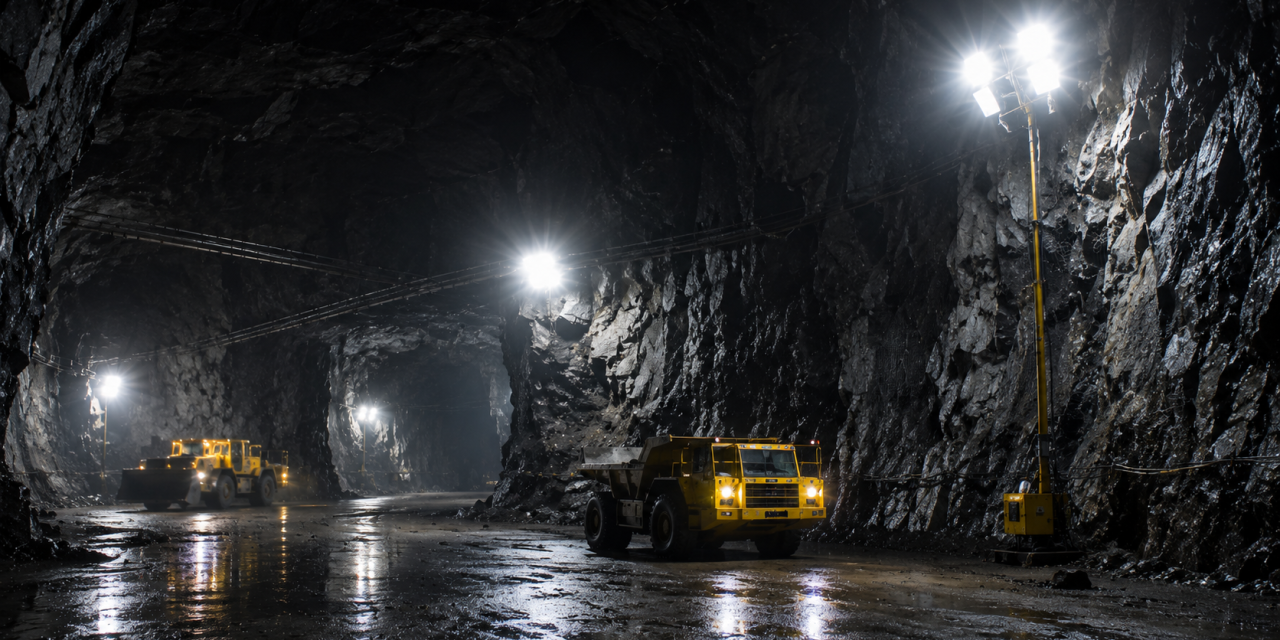
In the demanding environment of underground mining, the imperative for safety is absolute. This often leads to a seemingly logical conclusion: to see a hazard, you need light. Therefore, to eliminate hazards, you need ‘more’ light. This thinking manifests in the desire to install the brightest possible “mining floodlights” and “LED tunnel lights” in a uniform grid, aiming to bathe every corner of a drift, crosscut, or shaft in a blanket of high-intensity illumination. The assumption is that by turning night into day underground, we render all risks visible. This approach, while well-intentioned, is based on a critical misunderstanding of human vision, environmental interaction, and the true nature of underground hazards.
The Reality: How Uniform Over-Lighting Creates New Hazards
The human visual system is not a simple camera. It adapts, contrasts, and focuses. When an environment is lit with uniform, high-intensity light, several counterproductive effects occur.
intrinsically safe vs flameproof lighting selection
Glare and Visual Fatigue
“Mining lights”, especially high-output “LED mining lights”, are powerful sources. When positioned to flood an area, they often create points of extreme brightness directly in the sightlines of equipment operators and personnel. This glare causes immediate discomfort, but more insidiously, it forces the eye’s pupil to constrict rapidly. When the worker then looks away from the glare source into a shadowed area—which will inevitably exist around machinery, behind supports, or in irregularities of the rock face—their eyes cannot adapt quickly enough. This creates temporary ‘blind spots,’ precisely where hazards like fallen rock, discarded tools, or uneven footing may lie. Chronic exposure to such conditions leads to significant visual fatigue, reducing concentration and reaction times over a shift.
Loss of Depth Perception and Detail
Safety in a dynamic mining environment relies heavily on accurately judging distance, texture, and movement. Uniform lighting flattens perception. The strong contrasts and shadows that naturally define edges, gauge distances, and reveal the texture of a rock wall or the alignment of rail tracks are washed out. A subtle crack in a support beam, a sheen of water on the floor indicating a seepage point, or the slight misalignment of a conveyor belt becomes harder to detect. The light is present, but the *information* the light provides is degraded.
The Masking of Critical Signals
Modern mines are equipped with numerous visual safety signals: flashing lights on vehicles, warning beacons, color-coded piping and cables, and reflective markers. In an overly bright, uniformly lit space, these critical signals lose their salience. Their designed luminosity is drowned in the ambient ‘wash,’ making them less noticeable. An “explosion-proof mining light” fitting should illuminate the workspace, not compete with the emergency strobe it is supposed to reveal.
The Principles of Effective, Safe Mine Illumination
Moving beyond the myth requires a shift from quantitative thinking (lumens per square meter) to qualitative design (effective visual information delivery). Proper “industrial explosion-proof lighting” for underground applications follows core ergonomic and engineering principles.
leading Chinese mining LED light manufacturers
Task-Based Zoning
Lighting should be layered and zoned according to the specific visual task. High-precision work areas, such as maintenance bays or electrical installations, require high-quality, shadow-reduced light. Travelways, however, need consistent, glare-free illumination that emphasizes the path edges and vertical surfaces to aid navigation, not a sun-bright intensity across the entire tunnel diameter. “Mine tunnel lighting” should guide the eye, not overwhelm it.
Contrast Management and Vertical Illumination
The goal is to reveal the environment’s form, not just its existence. This requires careful management of contrast ratios and a focus on illuminating vertical surfaces—the rock face, rib walls, and equipment sides—where hazards and landmarks are most apparent. Strategic placement of “LED mining lights” to graze walls or highlight key infrastructure creates a more three-dimensional and intelligible space than overhead floodlights alone.
Spectral Quality and Emergency Integration
The color temperature and color rendering index (CRI) of LED sources matter. Lighting that closely mimics natural daylight can improve alertness and color discrimination, helping personnel distinguish between minerals, safe markings, and warning hues. Furthermore, all general lighting systems must be integrated with, and not impede, dedicated emergency and signaling lights. The ambient illumination should provide a backdrop that makes emergency systems stand out, not blend in.
Conclusion: From Illumination to Visual Clarification
The industry’s journey from incandescent bulbs to advanced “LED tunnel lights” and “explosion-proof mining lights” represents more than just an energy-saving upgrade. It is an opportunity to fundamentally re-evaluate how we use light as a safety tool. The myth of ‘floodlighting for safety’ persists from an era of limited technology and understanding. Today, we know that effective underground lighting is a sophisticated discipline akin to ergonomics. It is not about eliminating darkness absolutely, but about strategically sculpting light to clarify the environment, reduce visual stress, and make genuine hazards unmistakably visible. The safest mine is not the brightest one; it is the one where the lighting design works in harmony with human vision to create a workspace that is visually intelligible, comfortable, and inherently more secure.

关注同器机械官方公众号
微信搜一搜:同器机械
加微信咨询:15235312375