
The Lumen Fallacy in Underground Illumination
Walk onto any mine site or into a procurement discussion about underground lighting, and you will likely hear a familiar refrain: "We need the brightest lights possible." This translates into a singular focus on lumen output, the standard metric for the total quantity of visible light emitted by a source. While it seems logical—more light should equal better visibility—this narrow focus represents a significant and potentially costly misconception in industrial lighting strategy. For underground mining, where environments are confined, atmospheres can be hazardous, and tasks are critically detailed, equating lumens with quality is an oversimplification that can compromise safety, efficiency, and the total cost of operation.
The Complex Reality of Underground Visibility
Human vision and task performance in a mine depend on far more than the sheer volume of light flooding a tunnel. Consider a high-lumen LED floodlight mounted on a piece of equipment. It may produce an impressive number of lumens, but if that light is poorly distributed, it can create severe glare for operators of oncoming vehicles, casting their path into dangerous shadow. Conversely, it might leave the walls, roof, and critical infrastructure in deep darkness, failing to illuminate trip hazards, geological features, or equipment status.
This is where concepts like luminance uniformity, color rendering, and spectral distribution become paramount. Uniformity ensures there are no drastic, blinding contrasts between bright spots and dark voids, allowing the eye to adjust comfortably and perceive the entire scene. A light with a high Color Rendering Index (CRI) will accurately reveal the colors of wiring, geological strata, warning signs, and personnel clothing—a critical factor for identification and safety that a pure lumen count ignores. Furthermore, the spectral content of light can affect visual acuity; certain LED spectra can enhance contrast on rocky surfaces or in dusty air, providing clearer definition than a brighter but spectrally poor source.
The Non-Negotiable: Explosion-Proof Integrity and Robustness
The most luminous fixture in the world is worse than useless in a potentially explosive atmosphere if it is not properly certified. This is the cornerstone of industrial explosion-proof lighting. The myth that "a bright light is a safe light" is dangerously incomplete. Safety in hazardous locations (like zones with methane, coal dust, or flammable gases) is defined by a light's ability to contain any internal spark or flame and to operate without surfacetemperatures that could ignite the surrounding atmosphere.
An explosion-proof mining light is an engineered system. Its housing, lens seals, cable entries, and thermal management are designed and tested to rigorous international standards (such as ATEX, IECEx, or MSHA). These protective features are integral, not additive. Choosing a fixture based on lumens alone, without verifying its explosion-proof certification for the specific zone of use, introduces an unacceptable risk. The robustness of the fixture—its resistance to vibration from continuous operation of heavy machinery, impacts from falling rocks or collisions, and corrosion from humidity and chemical exposure—also directly determines its reliability and longevity. A fragile, high-lumen light will fail quickly, creating dark zones and frequent maintenance hazards.
The Systemic Approach: Lighting as Infrastructure
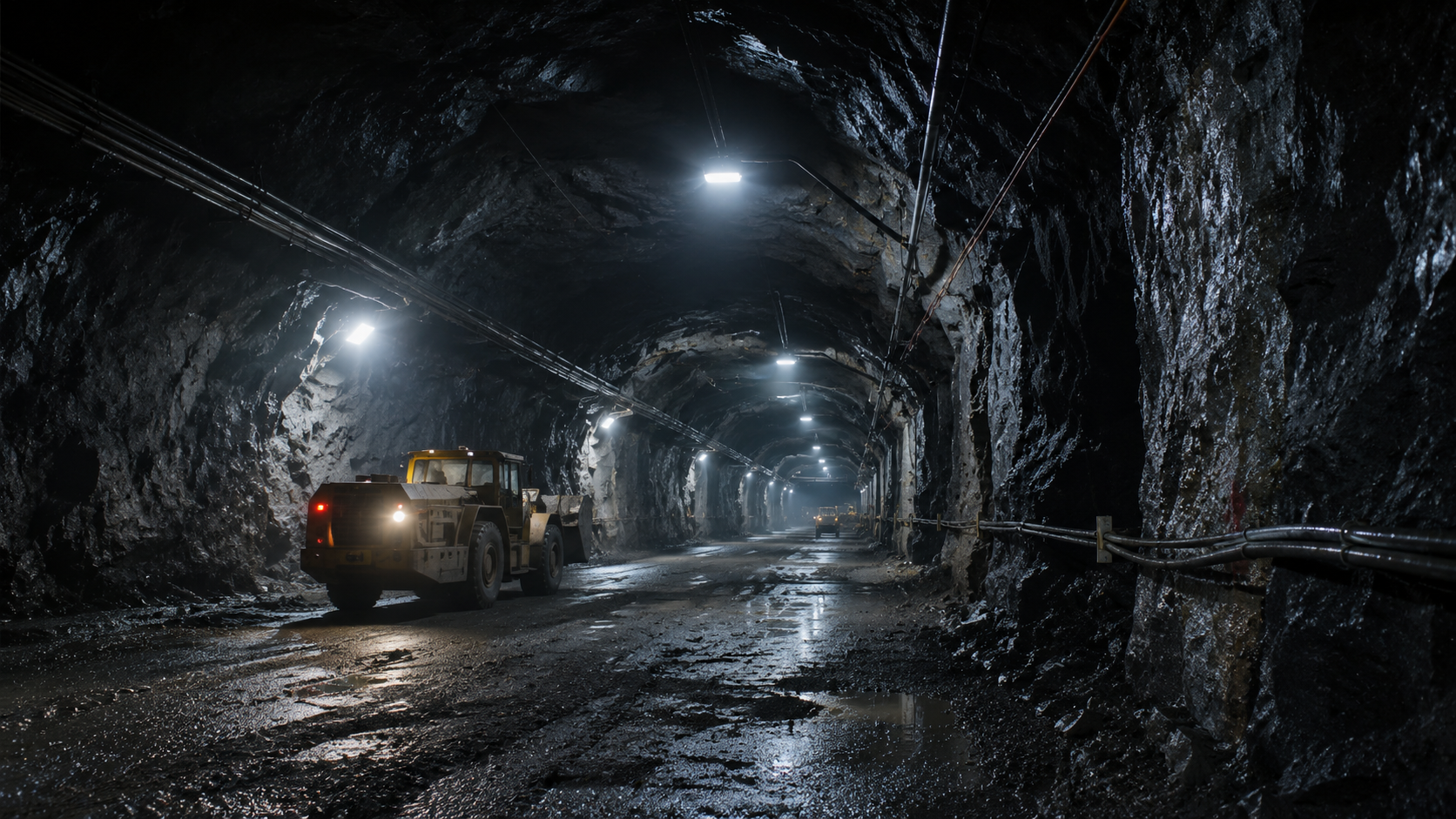
Effective mine tunnel lighting is not about installing individual bright spots; it is about designing a coherent visual system. This involves strategic placement to guide movement, highlight hazards, and illuminate task areas without causing disability glare. For example, lighting along haulageways must facilitate the safe passage of the largest vehicles, requiring careful attention to mounting height, spacing, and beam angles to provide a consistent "river of light." In development headings or at the mining face, lighting must support detailed geological inspection, drilling accuracy, and equipment maneuvering, demanding a different quality of light—often with better color rendering and targeted distribution.
Modern LED mining lights offer the toolkit for this systemic approach. Their directional nature allows for precise optical control. Advanced designs can provide asymmetric distributions that throw light far down a tunnel while also washing the nearby walls, or wide, even blankets of light for open work areas. This controllability means the right amount of light can be delivered exactly where it is needed, often achieving better visual outcomes with lower total lumen output than an array of unidirectional, glaring fixtures. It translates to energy efficiency and reduced glare-related fatigue for workers.
Conclusion: Redefining the Metric for Mining Lighting
The pursuit of better underground lighting must move beyond the simplistic lumen race. The true metric for a mining light is its total performance within the ecosystem of the mine: its ability to provide safe, high-quality visibility that enhances spatial awareness and task accuracy, its guaranteed integrity in hazardous environments, its durability against physical and environmental abuse, and its contribution to an efficient, well-planned lighting scheme. When specifying LED tunnel lights or mining floodlights, the questions should evolve from "How many lumens?" to "How is the light distributed?", "What is its CRI and spectral quality?", "Is it certified for this specific hazard?", and "How will it integrate into our overall lighting plan?" Dispelling the lumen myth is the first step toward lighting solutions that genuinely illuminate the path to safer, more productive, and more sustainable mining operations.